Operate and acquire
HERCULES executes automation, monitoring, health checks and data acquisition across the managed environment.


Understand how CIRMS Global Layers move from automation and trusted operational data toward AI-ready knowledge and the planned evolution to AI-assisted intelligence.
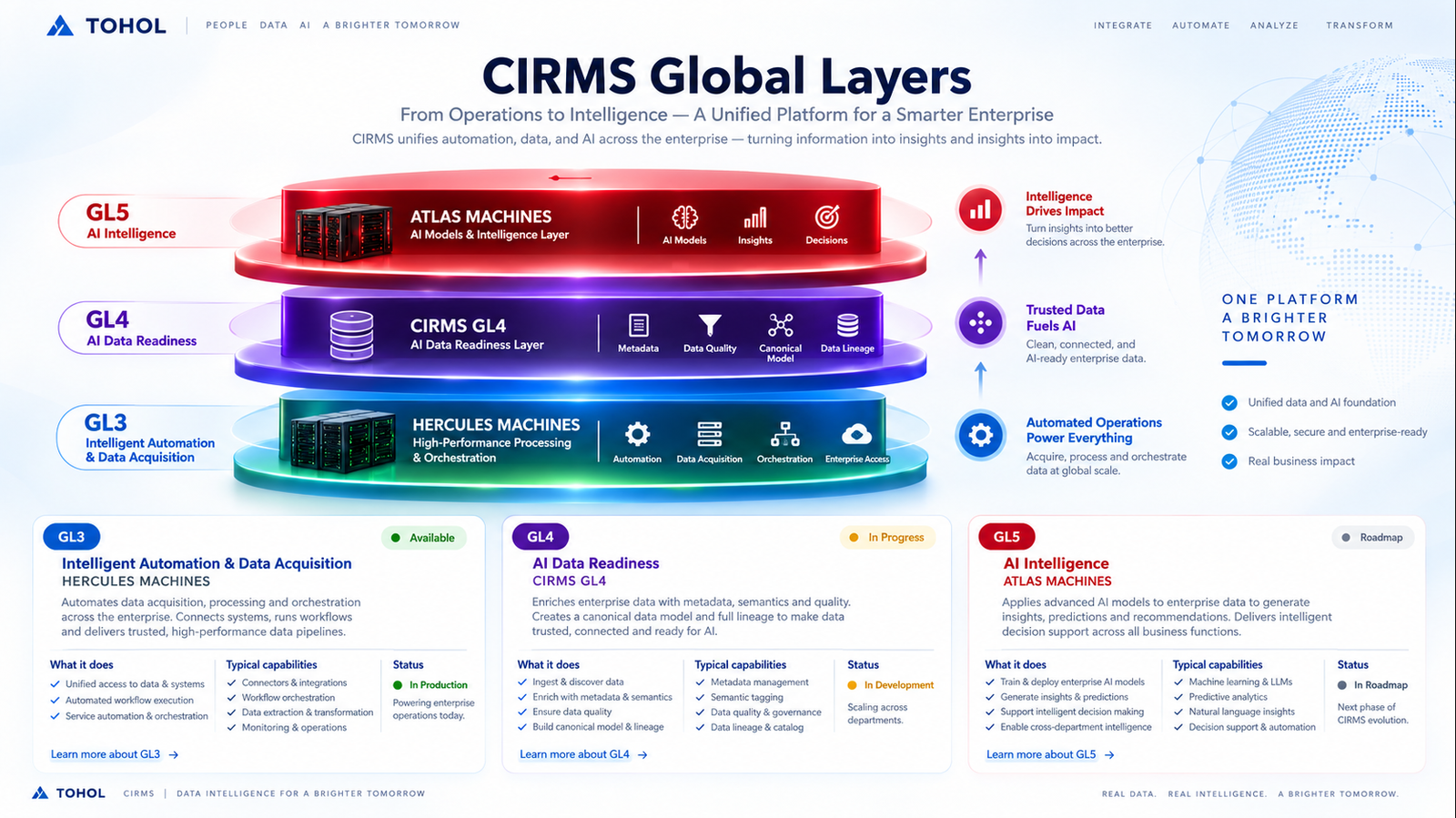
CIRMS is structured as a layered platform. GL3 automates and acquires operational data. GL4 prepares that information as AI-ready knowledge. The planned GL5 evolution is designed to use that prepared knowledge for AI-assisted analysis, recommendations and decision support.
HERCULES executes automation, monitoring, health checks and data acquisition across the managed environment.
Operational data is ingested, enriched, validated and organized into governed, AI-ready knowledge assets.
Future AI models and assistants are intended to operate on the prepared knowledge foundation created through GL3 + GL4.
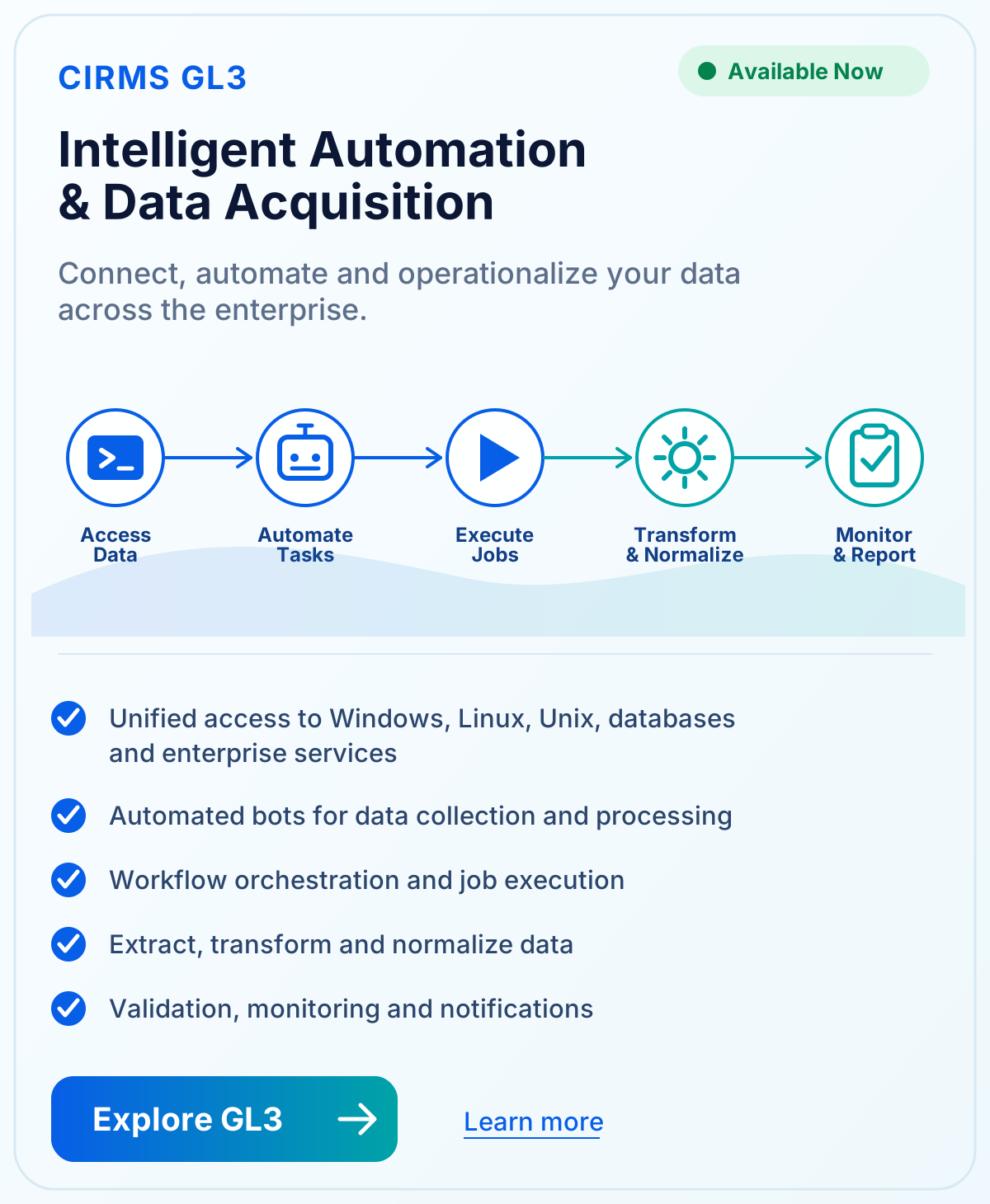
GL3 is the operational foundation of CIRMS. Running on HERCULES machines, it provides automation, orchestration, monitoring, health checks and controlled data acquisition across connected systems, databases, applications and services.
Its role is to capture operational reality in a structured and repeatable way. That includes executing jobs, collecting information, validating results and turning raw operational activity into usable data for the next layer.
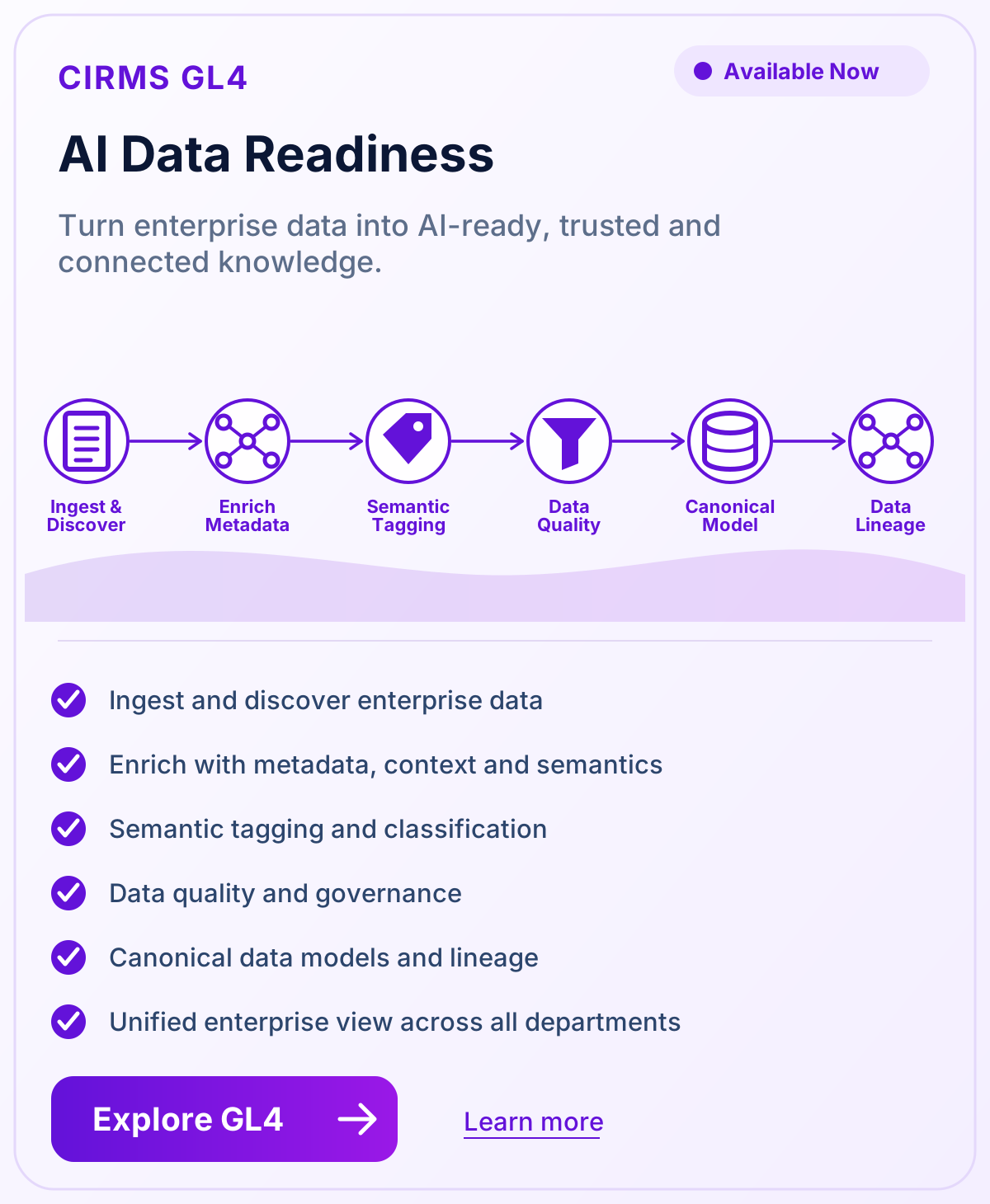
GL4 transforms the operational information acquired through GL3 into curated, governed and AI-ready knowledge. This layer prepares data so that it can be understood, validated and used more effectively by downstream analytical and AI workflows.
Within CIRMS, this preparation pathway covers ingestion and discovery, metadata enrichment, semantic tagging, data quality checks, structuring and lineage, while the confirmed CIRMS delivery path further extends into curation, document generation, chunk generation, vector embeddings and semantic validation.
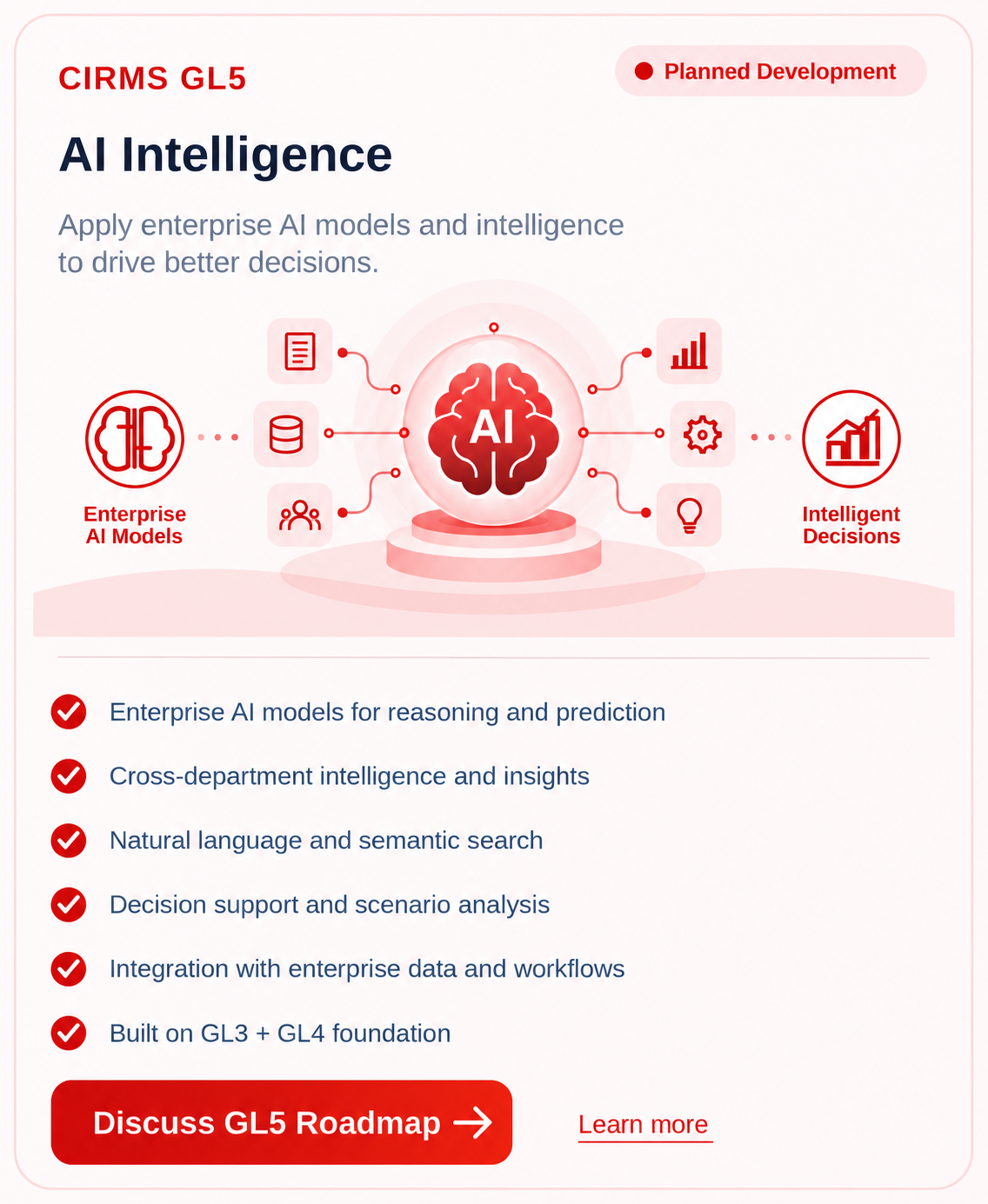
GL5 is the planned intelligence layer in the CIRMS roadmap. It is designed to activate enterprise AI on top of the trusted operational data acquired through GL3 and the governed knowledge prepared through GL4.
Rather than operating as an isolated AI feature, GL5 is intended to work with business context, human oversight and real enterprise workflows. In its planned form, it would support reasoning, semantic search, intelligent recommendations, conversational assistance and cross-department decision support.
Each layer has a distinct responsibility, but they work as one platform. GL3 creates the operational data foundation. GL4 transforms that foundation into AI-ready knowledge. The planned GL5 evolution is designed to apply intelligence to that prepared knowledge so people can act with more context and confidence.
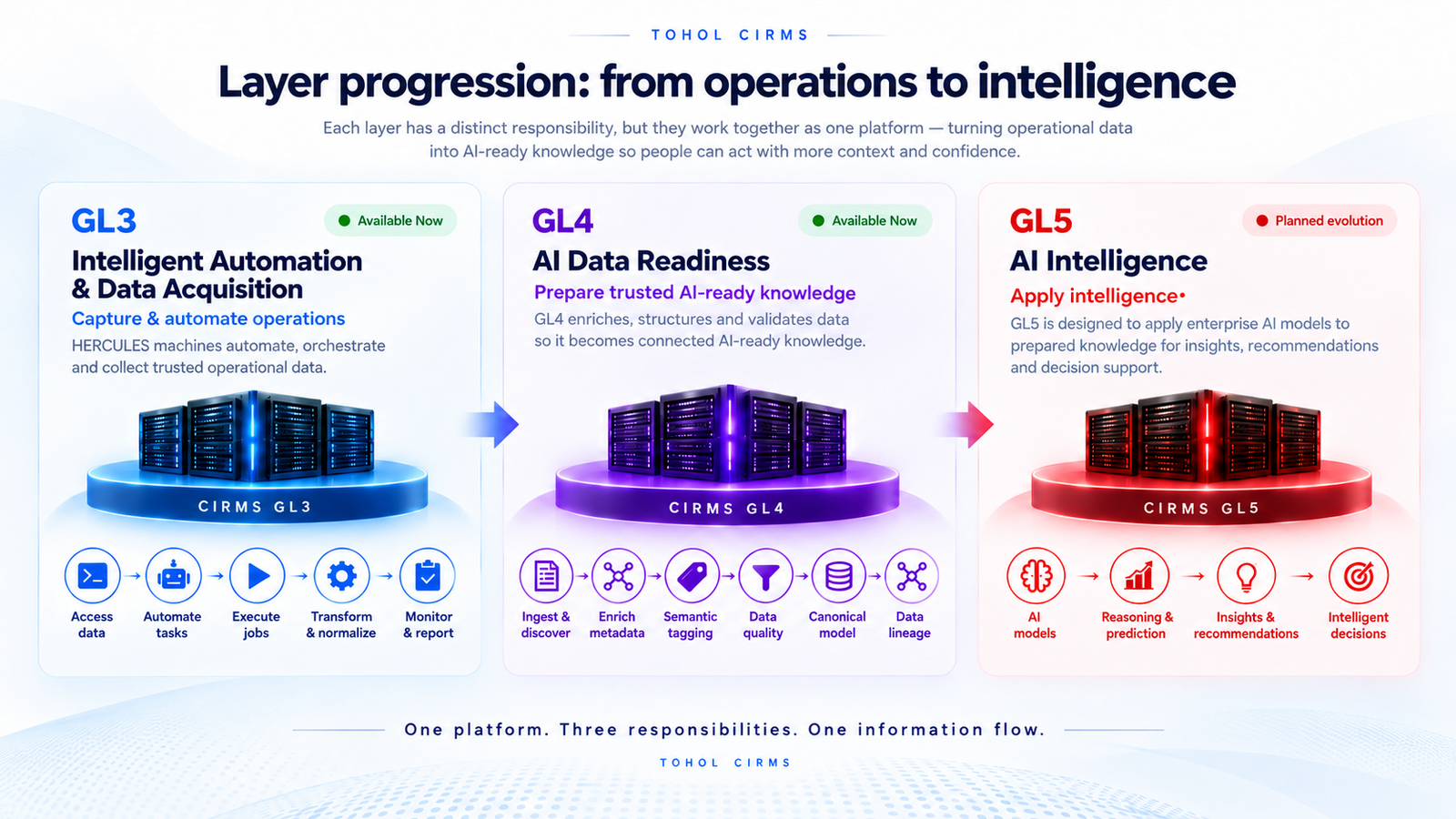
GL3 manages operational execution, monitoring and data acquisition through HERCULES.
GL4 enriches, structures and validates information so it becomes trusted AI-ready knowledge.
The planned GL5 evolution is intended to use that knowledge for insights, recommendations and decision support.
Use the Products page to review the three CIRMS offerings, then contact Project TOHOL® to discuss how GL3, GL4 and the planned GL5 roadmap relate to your environment and business objectives.