
Predictive Risk & Incident Prevention
Explore a planned workflow connecting monitoring signals with anomaly detection, risk prioritization and probable root-cause guidance for operations teams.
A roadmap scenario based on the original CIRMS GL5 use case. Not a production deployment or a guaranteed outcome.
Connect the signals before deciding on a response.
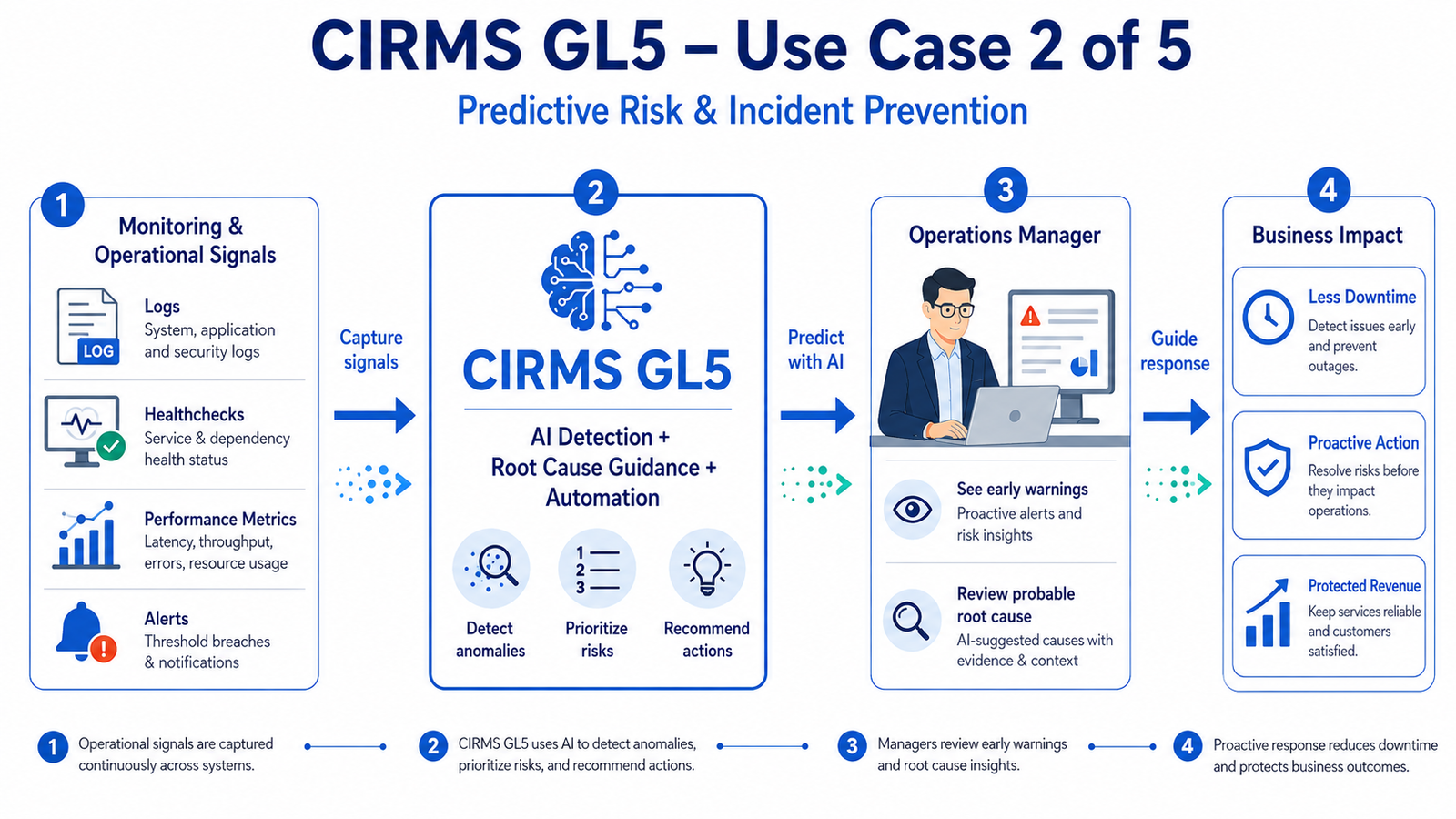
Logs, health checks, performance metrics and alerts can show different symptoms of the same issue. This GL5 concept proposes bringing those signals together to support a reviewed, prioritized response.
Information in scope
- Logs
- System, application and security records within the agreed scope.
- Health checks
- Available service and dependency health information.
- Performance metrics
- Latency, throughput, errors and resource usage.
- Alerts
- Threshold breaches, notifications and incident context.
How the scenario could work.
Follow the proposed path from approved information to AI-assisted review and a decision owned by people.
- 01
Capture operational signals
Collect the agreed logs, checks, metrics and alerts.
- 02
Explore planned GL5 detection
Assist with anomaly detection, risk prioritization and candidate actions.
- 03
Investigate probable causes
Operations managers review evidence and test alternative explanations.
- 04
Authorize a response
Use approved procedures and verify recovery rather than assume the issue is resolved.
Earlier investigation
Help teams focus on signals that merit attention.
Prioritized response
Assess likely impact and supporting evidence before action.
Service continuity
Aim to reduce disruption through reviewed response and follow-up.
The original use-case concept.
What sits behind the use case.
Separate the platform foundation from planned intelligence and the requirements of the target environment.
GL3 / GL4 & architecture
GL3 monitoring, health checks, alerts and operational automation provide the base. GL4 prepares the selected historical and contextual information for AI use.
AI & future extensions
Predictive risk scoring, AI anomaly detection and probable root-cause suggestions are planned GL5 extensions. Prediction is not proof of causation or a guarantee that an incident will be prevented.
People, data & permissions
Agree on collection intervals, signal quality, alert ownership and response authorization. Test false positives and missed incidents; define safe rollback and escalation procedures before action.
A bounded evaluation
Review a bounded set of historical incidents and known outcomes before considering any live AI-assisted incident workflow.
Candidate measures: detection lead time, false-alert rate, investigation time and verified recovery time. The page makes no downtime or revenue guarantee.