
AI Copilot for Faster Decisions & Reporting
A proposed conversational reporting workflow for turning approved KPIs, reports and service history into questions, draft summaries and reviewable management output.
A roadmap scenario based on the original CIRMS GL5 use case. Not a production deployment or a guaranteed outcome.
Ask a question. Review the evidence. Share the report.
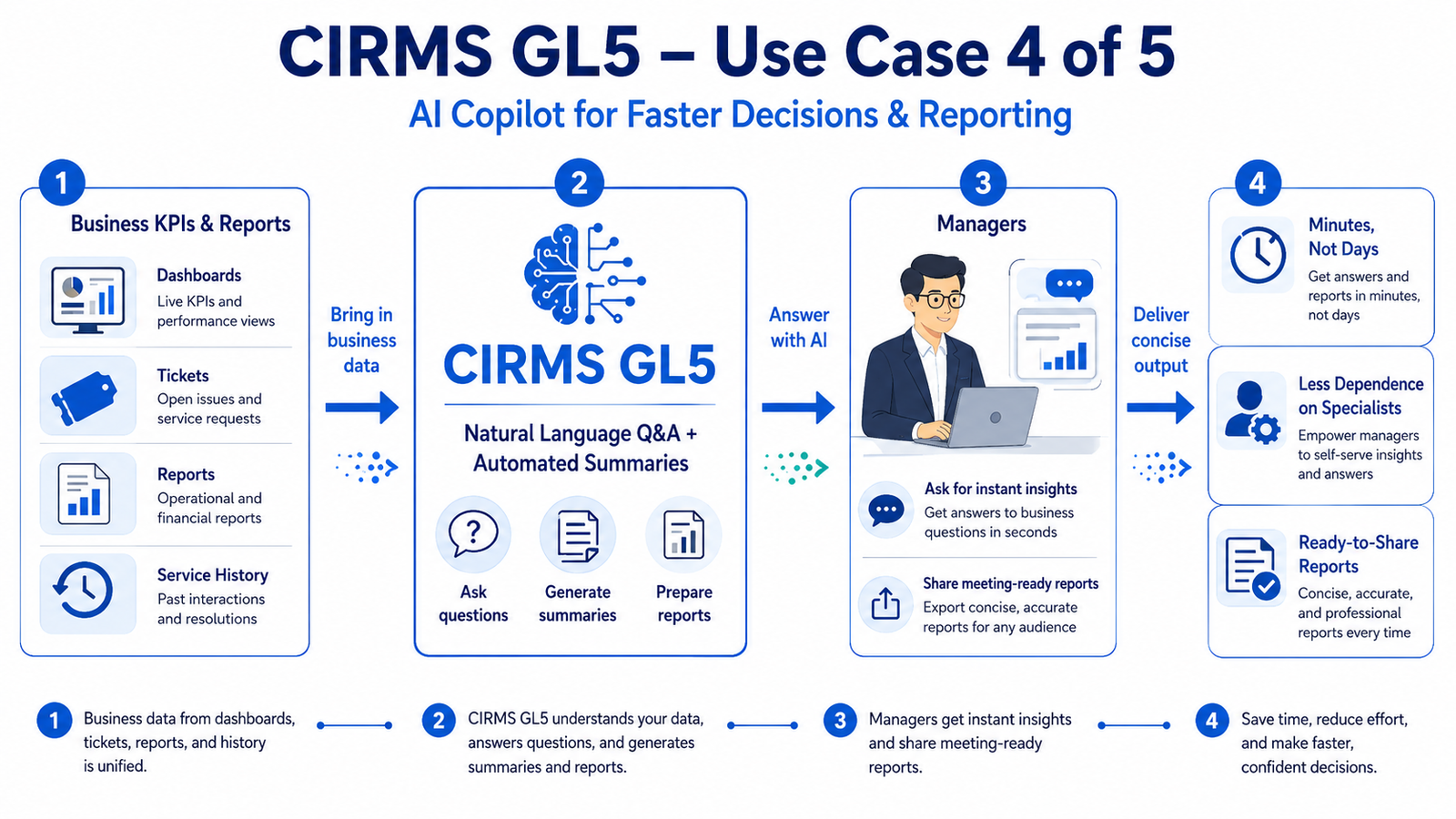
Recurring management reports can require time-consuming assembly and explanation. The CIRMS concept proposes natural-language Q&A and automated summaries, with managers reviewing the output before sharing it.
Information in scope
- Dashboards
- Business KPI and performance views.
- Tickets
- Approved issue and service-request information.
- Reports
- Operational and financial reports in the agreed scope.
- Service history
- Previous interactions, resolutions and relevant context.
How the scenario could work.
Follow the proposed path from approved information to AI-assisted review and a decision owned by people.
- 01
Bring in business data
Identify approved KPI, ticket, report and history sources.
- 02
Prepare a draft with planned GL5
Explore natural-language questions, summaries and report preparation.
- 03
Review the answer
Managers check sources, dates, assumptions and any unresolved uncertainty.
- 04
Share the reviewed output
Use approved summaries in meetings and operational discussions.
Less report assembly
Aim to reduce repetitive preparation work.
Self-service questions
Give managers a proposed route to explore approved information.
Shareable output
Prepare concise drafts for review, not unverified final reports.
The original use-case concept.
What sits behind the use case.
Separate the platform foundation from planned intelligence and the requirements of the target environment.
GL3 / GL4 & architecture
GL3 reporting and acquisition plus GL4 document, chunk and vector preparation form the proposed information foundation for a conversational reporting layer.
AI & future extensions
Conversational answers, generated summaries and AI-prepared reports are GL5 roadmap capabilities. The original diagram's speed and accuracy statements are goals, not measured service guarantees.
People, data & permissions
Agree on supported sources, permission boundaries, reporting definitions and review rules. Answers should be checked for omissions, unsupported conclusions and outdated information before use.
A bounded evaluation
Use a fixed collection of approved reports and a repeatable question set. Review draft answers alongside the source material with the intended report owners.
Candidate measures: preparation time, reviewer correction rate, source-reference coverage and the share of questions that require escalation instead of an answer.